As EU and India are trying forge a Free Trade Agreement (FTA), a leading India expert from Russia believes FTA between India and Russia-led Eurasia is much more doable and it doesn’t have hard conditions which EU wants to impose on India,
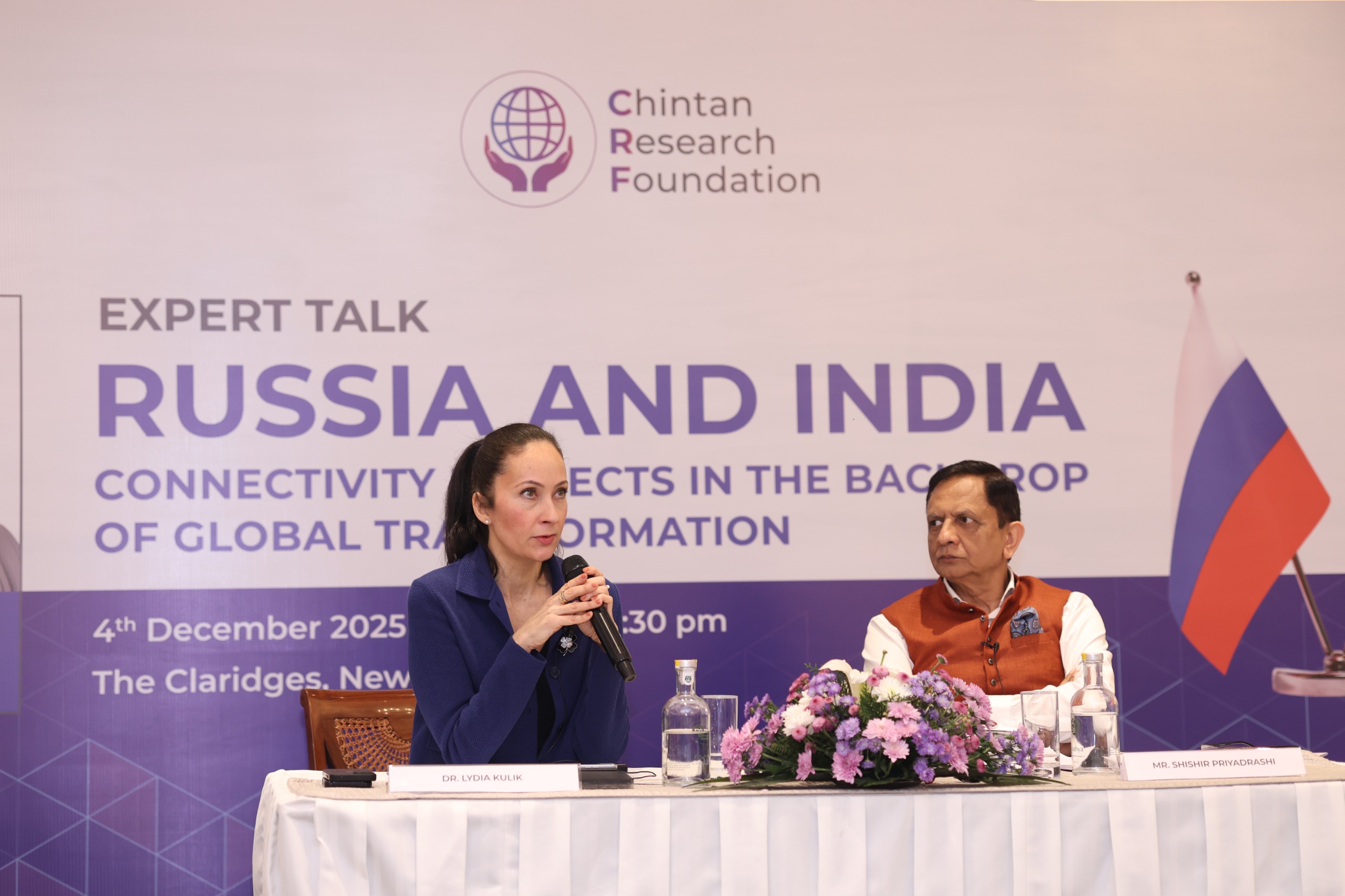
Dr Lydia Kulik, Head of India Studies at the Moscow School of Management and Senior Fellow at RAS Institute of Oriental Studies, who was here during the visit of Russian President Vladimir Putin, said the Russia-India relations have been moving from strength to strength and Moscow is working to bring India into the Eurasian Economic union fold. A breakthrough in FTA between the two is expected soon, Dr Kulik said. .
Russia has proposed the idea to link India with Eurasia and a breakthrough in the India-Eurasia negotiations on the Eurasian Economic union (EAEU) FTA is expected, according to Dr Kulik.
Dr Kulik was speaking at The Expert Talk, titled “Russia and India: Connectivity Projects on the backdrop of Global Transformation” organised by Chintan Research Foundation (CRF), coinciding with the visit of Russian President Vladimir Putin to India on December 4 and 5.
“The India-Russia relationship can be described as exemplary, predictable, and stable, withstanding the uncertainties posed by global incidents in the past couple of years,” said Dr. Lydia Kulik.
The talk brought together experts from the governments, academia, strategic community, industry, media, and private businesses across the domain to understand the various aspects of the strategic partnership that has historical time-tested excellence, based on adaptability and flexibility.
“The visit of President Putin offers an opportunity to understand the deep commitment both countries share and at the same time explore new avenues of cooperation, including some key connectivity projects, and the challenges that shape their strategic choices,” said Dr. Shishir Priyadarshi, President of CRF, while observing India and Russia have shared a partnership defined not only by statecraft but also by mutual respect, strategic convergence, and a consistent recognition of each other’s core interests.
India and Russia have traditionally shared political and strategic partnerships. However, these bonds have further strengthened in recent years while fostering economic partnership focusing on growing trade and diversifying in other avenues.
Dr Lydia highlighted the factors which have contributed to recent strengthening due to India’s neutrality in the face of West-led isolation of Russia.
She also underlined Russia’s economic resilience and stability, how the local entrepreneurs flourished after Western sanctions and have grown healthily in these turbulent times. Instead of slowing down, Russian economy grew defying expectations.
In fact that prompted its government to moderate growth to cool down inflation. Dr. Lydia underlined.
She also complimented India’s reformative transformation and the commitment by the two nations on increased digitalisation.
Addressing the issue of connectivity between India and Russia, she mentioned that currently there exists only one flight between two nations while there are multiple flights between Russia and China, recognising the need to work on more physical connectivity.
She also highlighted the scope of visa-free entry for Indian tourists in Russia, similar to that has been implemented between Russia and China.
She also highlighted the logistical modalities that need to be worked on, strengthening the North-South connectivity, especially the Northern Sea Route and the Chennai Vladivostok Maritime Corridor. Russia is already working on the feasibility of the projects, identifying the cost, geographic and security vulnerabilities, and resolving those.
Highlighting the factors defining India–Russia economic partnership, Dr Kulik put forth a few issues that need to be addressed, including logistic support, cost vulnerabilities, security in the Balkans and the Black Sea region.
These are of utmost concern for Russia to explore alternate options for its trade corridors, Dr Kulik noted.