India hosted the 2nd India-Arab Foreign Ministers’ Meeting on January 31 after a gap of 10 years. The meeting was co-chaired by India and the UAE.
The foreign ministers of other Arab League member states and the Arab League Secretary General participated in the 2nd India-Arab Foreign Ministers Meeting.
The India-Arab foreign ministers meeting is happening after a gap of 10 years. The first meeting was held in 2016 in Bahrain, which culminated in the Manama Declaration. At the first meeting, the ministers identified priority verticals of cooperation and proposed a set of activities across these verticals.
“The second meeting is expected to build on our existing cooperation, expanding and deepening this partnership. This is the first India-Arab meeting to be hosted by India in New Delhi and will see participation by all 22 Arab countries by Foreign Ministers, other Ministers, Ministers of State and other Senior Officials and the Arab League,” the Ministry of External Affairs (MEA) said in a statement here.
This was preceded by 4th India-Arab Senior Officials Meeting on 30 January, the MEA added.
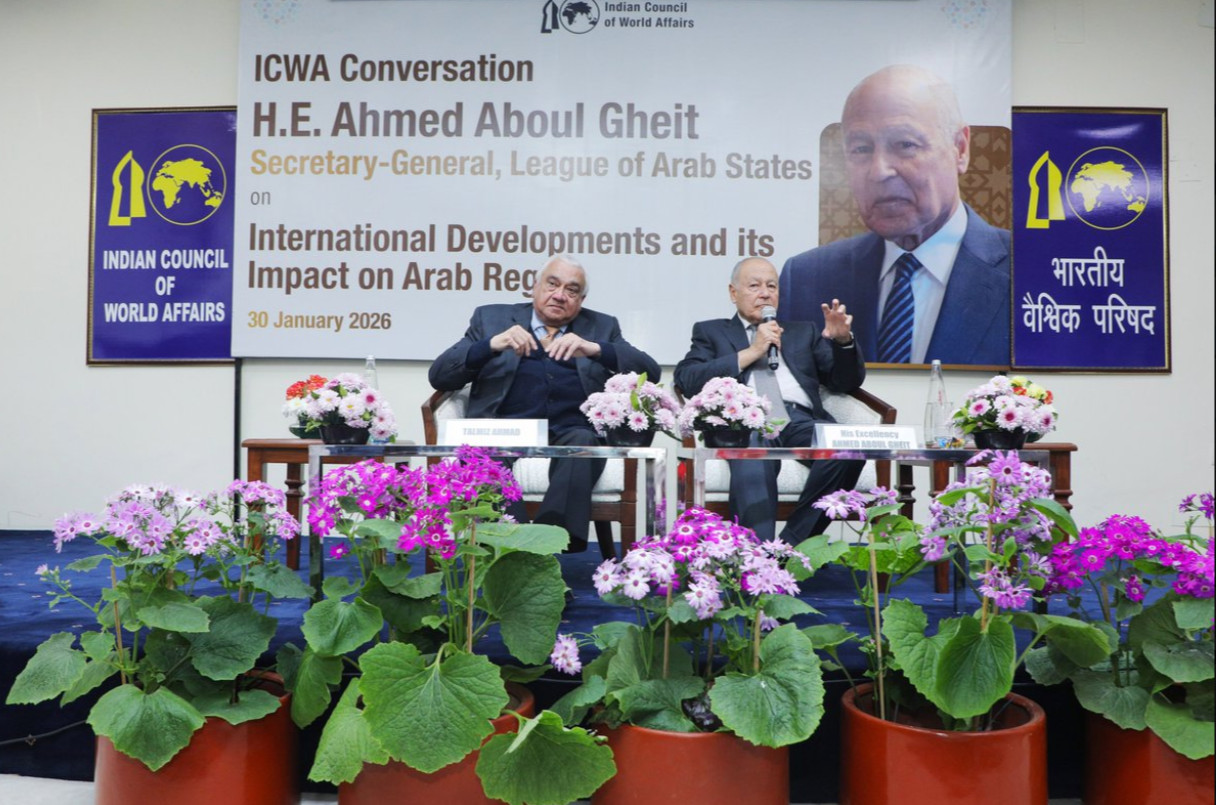
The Secretary General of the League of Arab States, Ahmed Aboul Gheit, also addressed the Indian Council of World Affairs (ICWA) on international developments and their impact on Arab states on Friday.
India-Arab Foreign Ministers’ Meeting is the highest institutional mechanism driving this partnership, which was formalised in March 2002 when India and the League of Arab States signed an MoU institutionalising the process of dialogue. A Memorandum of Cooperation was signed for the establishment of the Arab-India Cooperation Forum during the visit of the then Arab League Secretary General Amre Moussa to India in December 2008, which was subsequently revised in 2013 in terms of structural organisation. India is an Observer to the League of Arab States, a pan Arab body with 22 member States.
The first India-Arab Foreign Ministers’ Meeting was held on January 24, 2016, in Manama, Bahrain, which culminated in the adoption of the Manama Declaration and an Executive Program for 2016-2017. The Indian side was led by the then External Affairs Minister Sushma Swaraj, joined by the foreign ministers from the 22 member states of the League of Arab States or Arab League. The maiden event marked a transition from traditional ties to a formalised partnership.
The participating nations identified five primary pillars for future collaboration – economy, energy, education, media, and culture..
On the security and counterterrorism front India and the Arab side strongly condemned terrorism in all its forms, rejecting any association with specific religion or ethnic group. The participants called for a Comprehensive Convention on International Terrorism (CCIT).
The deliberations covered the Palestinian issue, affirmed support for a two-state solution, Syria, Yemen, Iraq, and Libya. The participants also agreed to step up cooperation in oil, natural gas, and renewable energy sectors.
Both India and the Arab side called for urgent reforms of the UN Security Council, advocating expanded permanent and non-permanent membership.
New Delhi sees Arab League nations as its “extended neighbourhood,” and a second home to 9 million Indian diaspora who live and work there.
The bloc constitutes India’s largest trading partner, accounting for a trade exceeding $240 billion and serves as India’s energy and food security through oil and phosphate imports. India was the first non-Arab nation to be granted Observer Status at the Arab League, underscoring its unique role as a credible partner in regional affairs and stability.