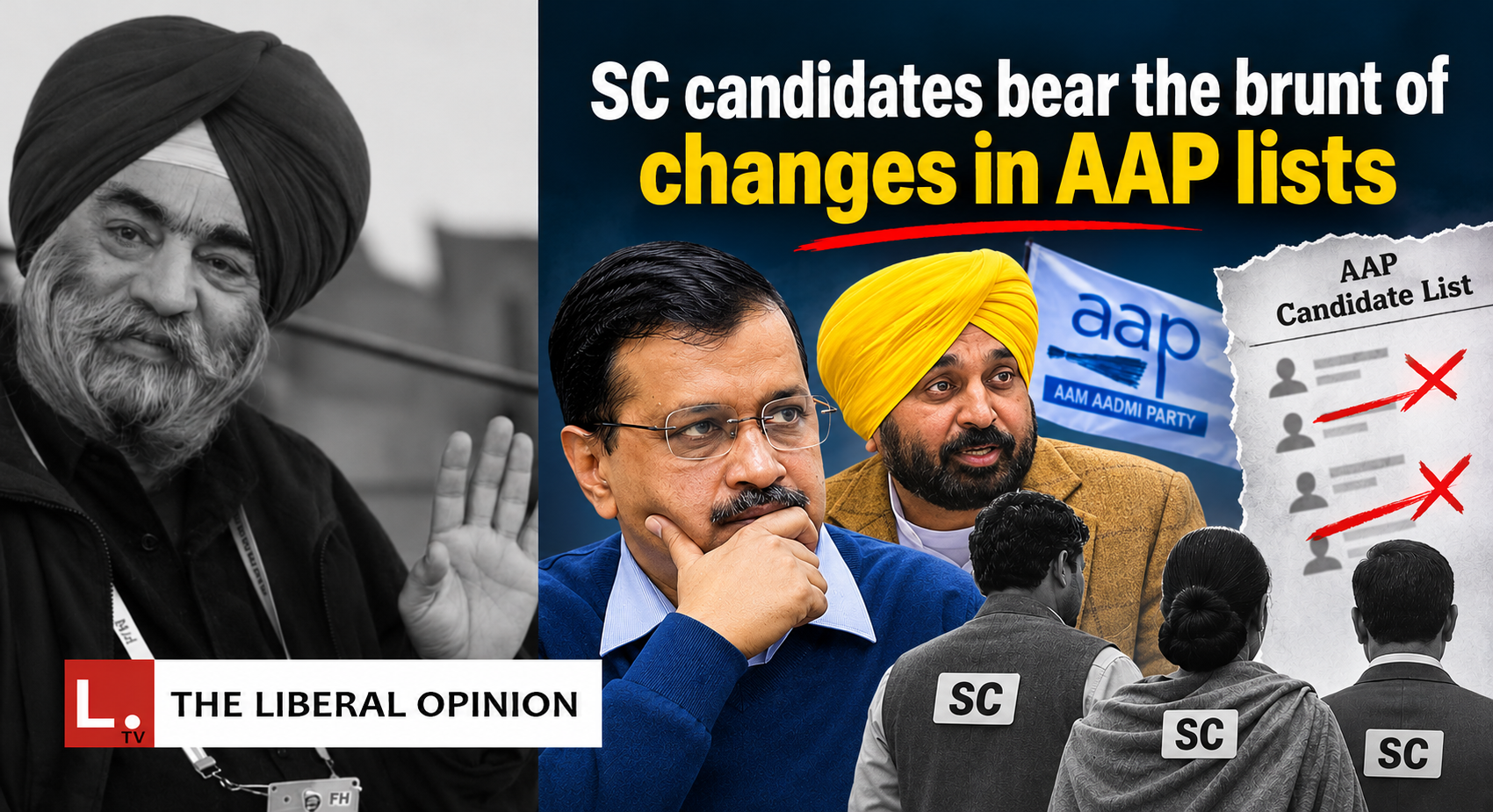
Politics: Numbers have taken over values as candidates belonging to SC bear the brunt in the first two lists of the AAP
The lead taken by Aam Aadmi Party (AAP) in releasing its first two lists of its candidates – 40 + 31 – for the 2027 Punjab Assembly elections has set in motion more than one animated debate in political circles not only in Punjab but also the rest of the country.
Questions are being raised over names of sitting legislators missing from these lists. Instead, two Members of Parliament figured in the second list of 31 candidates while two ministers – Gurmeet Singh Khudian and Anmol Gaggan – lost claims on the seats they held in the outgoing Vidhan Sabha. Others, who also served the Cabinet under Chief Minister Bhagwant Mann, too, have lost favour of the PAC of the party.
Other parties, including Congress, BJP and SAD, are still busy settling their internal organisational issues and impending alliances with like-minded political outfits. AAP has taken the lead, advantage of which will be known only when the actual battle of ballot is held early next year.
The Khudian family can draw some consolation that the seat presently held by Agriculture Minister Gurmit Singh Khudian will have a contestant in Randhir Singh Dhira Khudian, a nephew of the incumbent MLA.
Gurmeet Singh Khudian’s father, Jagdev Singh Khudian, sat in Lok Sabha as a representative of Shiromani Akali Dal. His death under mysterious circumstances, allegedly due to drowning, remained mired in controversies.
Now after one term in Punjab Vidhan Sabha, the ruling Aam Aadmi Party has decided not to continue with him. Gurmeet Singh Khudian, claiming himself to be a disciplined soldier of the party, has promised to extend all possible help and support to his successor candidate.
Anmol Gaggan Mann, who was elected from Kharar and was one of the youngest to become a Minister in her first term, has now been sidelined. Her place has gone to Parminder Singh Goldy. This was the riding which was first represented by senior journalist Kanwar Sandhu. He decided against seeking a re-election in 2022.
Another sitting MLA denied ticket is Dr Charanjit Singh. He has not taken well to his ouster from the Chamkaur Sahib (reserve) constituency from where he defeated the then Chief Minister and his name’s sake Charanjit Singh Channi.
Interestingly, majority of sitting MLAs denied tickets in the first two lists come from the Scheduled Castes category.
In Shutrana, also a reserved category, the sitting legislator, Kulwant Singh Bazigar has made room for Varinder Kaur Loomba, who earlier was associated with the Shiromani Akali Dal.
Another reserve constituency Chabbewal has an interesting tale of candidates. In the 2022 Assembly elections, this constituency was represented by Dr Raj Kuma Chabbewal. Two years later in 2024, he then left Congress and joined Aam Aadmi Party to guide his way into Lok Sabha through Hoshiarpur.
Now he has been nominated as AAP candidate for the Phagwara reserve constituency replacing another sitting Dalit legislator, Balwinder Singh Dhaliwal.
The PAC of AAP has also decided to deny the ticket to Laljit Singh Bhullar (he remained a Cabinet minister) from Patti replacing him with Jassa Patti (Jaskanwar Singh Gill).
Since Kunwar Vijay Pratap Singh, a former Punjab cadre IPS officer, who represented Amritsar North decided to quit the party and joined BJP, the ticket for his constituency has gone to Karamjit Singh Rintu.
Other two AAP MLAs, who quit the party and joined BJP – Chetan Singh Jaurmajra (Samana) and Harmit Singh Pathanmajra (Sanour) have also made room for new candidates. Chetan Singh Jaurmajra also remained a Cabinet Minister in the Bhagwant Mann Government. He was involved in the unsavoury controversy with the Vice Chancellor of Baba Farid Medical University, Dr Raj Bahadur.
Another AAP politician who has been swinging between Lok Sabha and Vidhan Sabha is Gurmeet Singh Meet Hayer. He represented Barnala in 2017 and 2022 Punjab Vidhan Sabha and remained a Cabinet Minister before he was declared a candidate for the 2024 Lok Sabha elections from Sangrur and won against Sukhpal Singh Khaira of Congress. Now, he is seeking a return to the State politics and party has nominated him its candidate for Barnala assembly constituency again.
Change is the only thing that is permanent and politics is no exception to this golden rule. Political Affairs Committees (PACs) and not people choose the candidates to govern them.
Basic postulates enshrined in the Constitution that select few chosen during the festival of democracy – the elections – will dedicate themselves to the cause of the wellbeing of the populace they represent.
Volunteering themselves to the public cause, they are mandated to defy hefty salaries or perks to take up the assignments, terms of which are governed by the constitutional provisions.
Terms may be extended subject to subsequent mandates. Terms in office, perks and salaries are the basic ingredients that distinguish politicians from those serving the people through executive or judiciary.
Of late, this distinction has vanished as the politicians through their own legislations not only enhance their salaries, perks and pensions but also shun the eligibility criteria other wings of functional democracies have. The foremost of these criteria is the age for superannuation. Bureaucrats and judges retire but not the politicians.
While other wings must abide by the rules and regulations governing their service conditions, all the politicians need are the numbers to stay in power. And they have the ways and means to keep the numbers on their sides.
Numbers have become so sacrosanct that they would switch loyalties to hog the limelight thus sacrificing the avowed mandate of serving the populace with sincerity and dedication.
If Punjab is at crossroads, both on fiscal and social fronts, the blame squarely comes on politicians more than other pillars of democracy.
Their oft-repeated promulgations that they are committed to “Sewa” –serving people in free, fair and transparent manner – than governing them is nothing more than a mere change of nomenclature. Rather, it has become a joke. Many want them to govern in a transparent and honest manner and leave the “Sewa” part to the voluntary organisations, including religious and social bodies.
The most pertinent question “Are politicians performing Sewa or ruling the people?” needs to be answered as the problems facing the people at large are multiplying.
India got its freedom in 1947. After 79 years, they are struggling to get clean and potable drinking water?
Questions have been raised about how safe is drinking water supplied through the public supply systems or even roadside handpumps or water posts?
Does early announcement of candidates for assembly elections help solve this basic problem? Your answer is as good as mine.
Let us move to the second necessity – neat and clean air? Can any political party or leader claim that air in Punjab is clean and free from deadly pollutants?
For Punjabis, their land holdings are very precious for them. How healthy is the land they proudly claim to be the symbol of their social status in a question even the best tiller of land would be reluctant to answer.
Punjab has one of the most polluted land masses and its underground water is poisonous and air is highly contaminated. Then what our politicians had been doing for the last 79 years.
The biggest problem that is wreaking the social fabric of the State is the ever-growing menace of drugs. All major parties, even after enjoying two-third majority in the State Legislature – Congress under Beant Singh Government, SAD-BJP alliance under Parkash Singh Badal and now the APP Government under Bhagwant Mann – have miserably failed to some of the contagious and long-standing problems of the State.
Question may persist: “Will their numbers in elections help mitigate public grievances?”
(Prabhjot Singh is a veteran journalist with over three decades of experience of 14 years with Reuters News and 30 years with The Tribune Group, covering a wide spectrum of subjects and stories. He has covered Punjab and Sikh affairs for more than three decades besides covering seven Olympics and several major sporting events and hosting TV shows.)